
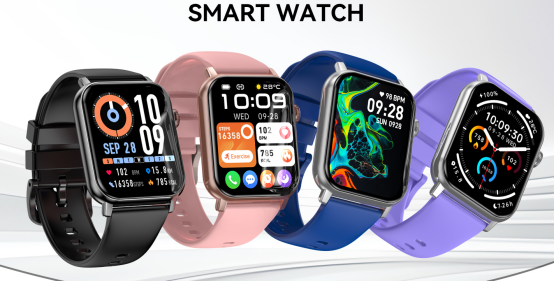
Smart watches have moved far beyond being a simple phone companion on your wrist. They now track sleep stages, monitor heart rhythms, estimate stress levels, guide workouts, handle contactless payments, and even serve as subtle fashion pieces. What began as a novelty has grown into one of the fastest-expanding categories in consumer electronics. Today the worldwide smartwatch market is a multi-billion-dollar industry, with hundreds of millions of people wearing one daily.
Market Size and Growth Momentum
The global smartwatch market passed the $50 billion mark in retail value a couple of years ago and continues to expand steadily. Most analyst firms place current annual revenue in the $60–75 billion range, with unit shipments running between 180 million and 220 million pieces per year. Year-over-year growth typically sits between 10% and 18%, depending on the quarter and the source.
Several factors keep the momentum alive even after years of strong expansion:
- Health and wellness features are now expected in almost every model. Continuous heart-rate monitoring, sleep-stage estimation, blood-oxygen readings, stress tracking through heart-rate variability, and basic ECG capabilities appear in mid-range devices and above.
- Older populations in high-income countries are adopting wearables for safety features such as fall detection, irregular heart-rhythm alerts, and medication reminders.
- Price points in emerging markets have dropped sharply. Reliable models under $100 from local brands and large Chinese manufacturers are selling in huge volumes.
- Post-pandemic awareness of personal health metrics has not faded; wearing a device that quietly watches vital signs around the clock has become normal behavior for many.
Longer-term forecasts project the market to reach $100–150 billion within the next five to seven years. The higher end of that range assumes continued breakthroughs in non-invasive glucose monitoring, cuffless blood pressure, and more advanced AI-driven coaching. The lower end assumes saturation in wealthy regions and slower uptake in lower-income areas.
Regional Patterns: Where Volume and Value Concentrate
North America remains the highest-revenue region per unit sold. Average selling prices frequently fall between $300 and $450, driven by premium models and strong ecosystem loyalty. Apple usually captures 55–65% of the value share here, followed by Samsung and Garmin.
Western Europe follows a similar pattern—premium focus with slightly lower average prices. Garmin and Fitbit hold larger shares among people who prioritize outdoor activities and detailed fitness logging.
China leads the world in sheer unit volume, often accounting for 35–45% of global shipments. Intense competition among Huawei, Xiaomi, OPPO, and numerous smaller brands keeps prices aggressive and features packed even in entry-level models. Apple maintains a strong premium position but holds a smaller slice of total units.
India currently shows the fastest percentage growth among large markets. Annual shipments have been rising 40–60% in recent years, fueled by aggressive pricing from domestic brands such as Noise, Fire-Boltt, and boAt in the sub-$100 segment. Apple and Samsung compete fiercely at the higher end.
Southeast Asia (Indonesia, Vietnam, Thailand, Philippines) is following a similar trajectory—rapid volume gains concentrated in affordable models.
Latin America and Africa remain earlier in the adoption curve but are accelerating, largely thanks to low-cost Chinese brands that offer basic smart features at prices accessible to the emerging middle class.
Leading Brands and Market Positions
Apple continues to dominate revenue share (typically 45–55% of global value) even though its unit share hovers around 20–25%. High average selling prices and deep integration with iPhones create strong loyalty in premium segments.
Samsung usually sits in second place for both value and volume in Android-dominated regions. It performs especially well in South Korea and other parts of Asia.
Huawei has regained substantial ground in China and selected international markets after earlier supply-chain challenges. Mid-to-high-end models compete strongly on battery life, health sensors, and pricing.
Xiaomi and its sub-brands (Redmi, Poco) are volume leaders in many emerging markets. They frequently rank first or second in unit shipments in India, Southeast Asia, and parts of Europe thanks to aggressive pricing and feature-rich entry-level devices.
Garmin maintains a focused but highly profitable position. It leads among serious runners, cyclists, triathletes, golfers, and outdoor enthusiasts who value long battery life, advanced training metrics, and rugged construction over general smart features.
Fitbit (owned by Google) has stabilized after the acquisition. It retains strength in North America and Europe among casual users focused on step counting, basic fitness, and sleep insights.
Other fast-growing names include Amazfit (Huami), Noise, boAt, Realme, OnePlus, Nothing (CMF sub-brand), and Coros (popular with ultra-endurance athletes).
Major Technology and Design Trends
Health-sensing capabilities keep expanding Temperature sensing has become standard in mid-range and premium models, enabling better cycle tracking, ovulation prediction, and early illness alerts. Non-invasive blood glucose remains the most anticipated future feature, though consumer-ready accuracy and regulatory clearance are still several years away.
AI-driven coaching and personalization On-device processing allows more context-aware suggestions (“Your recovery is strong—try intervals today” instead of generic prompts). Some brands are experimenting with natural-language voice queries for quick insights.
Battery life returns as a priority After years of prioritizing brighter displays and additional sensors, consumers are demanding longer runtime. Mid-range models increasingly offer 5–10 days of use, while premium lines push toward multi-day performance through aggressive power management.
Fashion-forward materials and designs Titanium cases, sapphire crystals, ceramic finishes, leather-hybrid straps, Milanese loops, and designer collaborations are expanding rapidly. In many markets, especially Asia, watches are now as much jewelry as technology.
Specialized segments gain traction Children’s models with GPS tracking, SOS buttons, school-time restrictions, and parent controls are growing quickly in China, India, and parts of Europe. Senior-focused devices emphasize fall detection, medication reminders, irregular-rhythm alerts, and simplified interfaces.
Subscription experiments emerge A few brands are testing premium features behind paywalls (advanced running analytics, guided breathing sessions, detailed sleep coaching). User resistance remains high, so widespread adoption is slow—but the model is being tested.
Challenges Facing the Industry
Saturation in mature markets Growth in North America, Western Europe, Japan, and South Korea has slowed to mid-single digits. Replacement cycles are lengthening as many owners find current models still meet their needs.
Privacy and data-security concerns More sensors collect more personal information. Continuous temperature, HRV, blood oxygen, and location tracking raise legitimate questions. Brands are improving on-device processing and opt-in controls, but trust issues persist.
Competition from smart rings and alternative wearables Oura, Ultrahuman, RingConn, and similar devices are gaining attention among users who dislike wrist wear. They excel at sleep and recovery metrics but lack notifications, apps, music, and payments. For now they complement watches rather than replace them, but the rivalry is growing.
Regulatory and technical hurdles Non-invasive glucose, reliable cuffless blood pressure, and advanced ECG approvals move slowly. Overstating capabilities risks classification as a medical device, which brings heavy oversight.
Looking Ahead
The smartwatch market is maturing rather than exploding. Growth is shifting from “does it work at all?” to “does it work better for my exact routine?” Brands that solve real user pain points—battery anxiety, skin comfort, actionable insights instead of raw data dumps—will continue gaining share. Those chasing specification wars without addressing daily frustrations will lose ground.
For the majority of people today a solid mid-range model or a one-generation-old flagship delivers nearly everything the newest device offers—at half the cost. The category has reached the stage where “good enough” is genuinely good enough for most users. The biggest winners are those who choose the device that matches their actual daily needs and ignore hype around features they will rarely touch.
The wrist remains one of the most convenient places for technology to live. It is only getting smarter—quietly, affordably, and one practical improvement at a time.
Leave a Comment
Your email address will not be published. Required fields are marked *