
Thermal management in smart watches is one of those behind-the-scenes engineering challenges that users rarely notice until something goes wrong. A watch that stays comfortably cool during a long run or overnight charging feels reliable; one that gets noticeably warm against the skin or throttles performance to avoid overheating quickly frustrates. Because the device sits directly on the wrist—skin that’s sensitive to temperature changes and has limited ability to dissipate heat—every watt of power consumed must be handled carefully. The goal is simple: keep internal components below safe operating temperatures (typically 45–50°C for skin contact and 60–70°C for the battery and processor) while maintaining full functionality.
Heat sources inside a smart watch are few but potent. The processor (SoC) generates the most heat during intensive tasks—GPS mapping, music playback, LTE data transfers, or rendering complex watch faces. The display, especially always-on AMOLED panels, produces steady warmth even at low brightness. Wireless charging coils and the charging IC create localized hotspots on the back cover during fast-charge sessions. Optical heart-rate LEDs pulse continuously in some modes, adding small but cumulative heat. Radio transmitters (Bluetooth, Wi-Fi, cellular) contribute during active use. All of this happens in a volume roughly the size of a large coin, with almost no room for traditional cooling solutions like fans or large heatsinks.
Passive heat spreading is the primary defense. The back cover—often stainless steel, titanium, aluminum, or ceramic—acts as a thermal mass and radiator. Metals conduct heat well and spread it across a larger surface area, reducing peak temperatures at any single point. Ceramic backs, popular in premium models, offer lower thermal conductivity than metal but excellent emissivity (they radiate infrared heat efficiently) and feel cooler to the touch because they don’t conduct heat as aggressively to skin. Some designs laminate thin graphite sheets, copper foils, or vapor chambers behind the battery or SoC. These materials have extremely high in-plane thermal conductivity (hundreds to thousands of W/m·K), pulling heat away from hotspots and distributing it evenly across the chassis. Vapor chambers—tiny sealed copper envelopes containing a working fluid—evaporate at hot spots and condense elsewhere, creating a near-isothermal spreader that’s remarkably effective in such confined space.
Thermal interface materials (TIMs) bridge gaps between heat-generating chips and spreading layers. Thin layers of thermal gel, phase-change pads, or graphite pads fill microscopic air gaps that would otherwise act as insulators. These materials ensure efficient heat flow from the SoC die to the back cover or internal shield. In some high-end watches, a small copper slug or direct-bonded copper pad sits directly on the processor, transferring heat to the graphite spreader or metal chassis.
Active thermal throttling is the last line of defense. Temperature sensors—usually NTC thermistors—sit near the battery, SoC, and charging circuit. When readings approach predefined thresholds (often 42–45°C for skin-facing surfaces), the system begins to limit power. This can mean reducing processor clock speed, dimming the display, shortening GPS fix intervals, lowering wireless transmit power, or pausing intensive tasks like continuous heart-rate sampling. In extreme cases, charging stops entirely until temperatures drop. The throttling is usually gradual and context-aware: during a workout it prioritizes keeping GPS and heart-rate data accurate, while at rest it can be more aggressive to protect battery health.
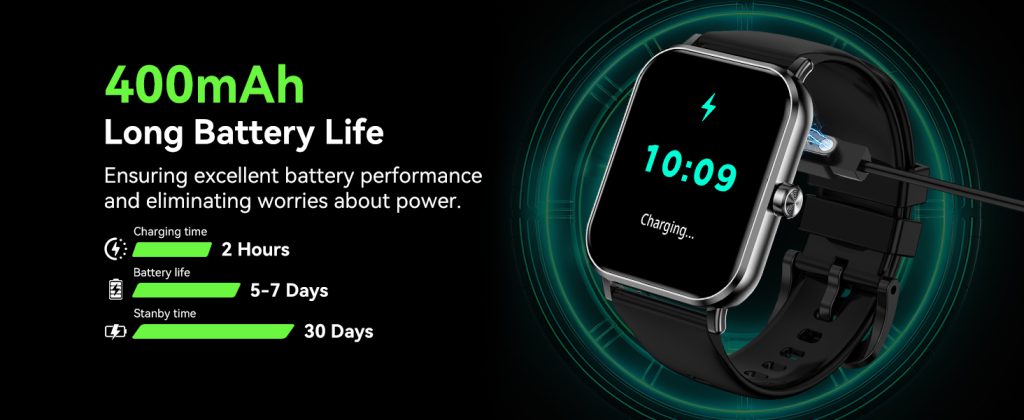
Charging generates some of the most noticeable heat. Inductive coils and rectification circuitry can reach 50–60°C locally during 5–10 W fast charging. Magnetic pucks help by increasing surface area and pulling heat away from the watch body. Some chargers include small heat sinks or fans in the base, though most rely on passive dissipation. The watch itself often slows charging current when internal temperature rises, extending charge time but preventing discomfort or accelerated battery aging. Optimized charging algorithms learn daily routines—holding at 80% overnight and topping to 100% just before wake-up—to minimize time spent at high voltage and temperature.
Battery chemistry influences thermal behavior. Lithium-polymer cells are sensitive to heat; prolonged exposure above 45°C accelerates capacity fade and increases internal resistance. Manufacturers use advanced separators, electrolytes with higher thermal stability, and sometimes ceramic coatings to improve safety margins. Charging current is dynamically adjusted based on temperature—higher when cool, lower when warm—to balance speed and longevity.
Software plays a growing role in thermal orchestration. On-device machine learning can predict heat buildup from usage patterns (a long GPS run after music streaming) and preemptively downclock components or reduce sensor polling before temperatures climb. Firmware updates frequently refine these behaviors, often yielding noticeable improvements in sustained performance and perceived warmth.
Real-world performance varies. A titanium-bodied watch with graphite spreading and aggressive throttling feels cooler during workouts than an aluminum model with minimal internal layers. Ceramic backs tend to stay comfortable longer because they transfer less heat to skin despite similar internal temperatures. Heavy users—those who enable always-on display, continuous monitoring, and frequent LTE—notice warmth more often, while casual users rarely encounter issues.
Future directions include even better materials. Micro-LED displays promise lower power (and thus less heat) for the same brightness. Solid-state batteries could tolerate higher temperatures without degradation. Advanced vapor chambers or graphene-based spreaders may become thinner and more effective. AI-driven thermal prediction could become proactive—adjusting settings minutes before a predicted hotspot forms.
Thermal management in smart watches isn’t flashy; it’s a collection of small, precise decisions that keep the device comfortable, safe, and performant. When you wear a watch for hours without thinking about heat, that’s the engineering working exactly as intended.
Leave a Comment
Your email address will not be published. Required fields are marked *