
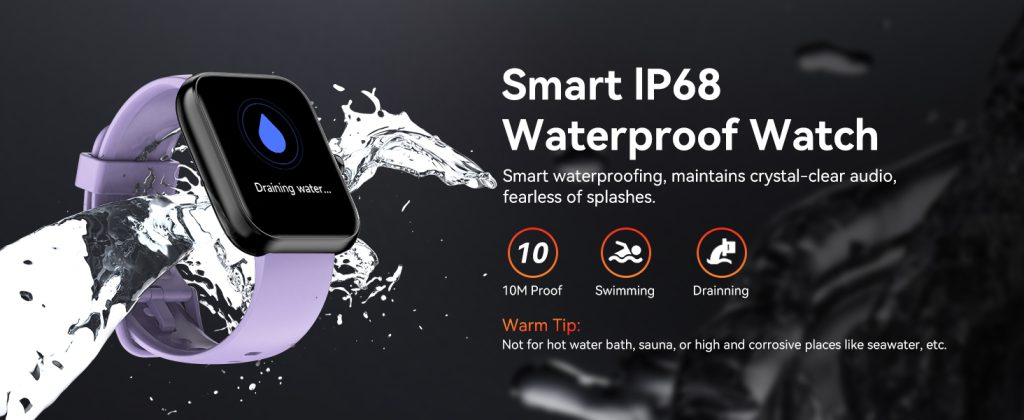
Making a smart watch truly waterproof involves far more than slapping on a rubber gasket and calling it IP68. The design has to survive everyday abuse—sweat during runs, sudden rain, hand-washing dishes, accidental plunges in the pool—while keeping tiny electronics safe from even microscopic amounts of water over years of use. Manufacturers balance slim profiles, responsive touchscreens, speaker grilles, microphones, and charging contacts with seals that must remain reliable through temperature swings, UV exposure, and mechanical flexing.
The foundation starts with the case materials. Most premium smartwatches use 316L stainless steel, titanium, or aluminum alloys for the main body because they resist corrosion far better than cheaper metals. Ceramic or sapphire crystal bezels and backs add durability and reduce galvanic corrosion when mixed with other materials. The display cover is almost always sapphire crystal or strengthened glass with oleophobic coatings; these materials don’t degrade or crack easily under pressure, and their low water absorption prevents long-term fogging inside.
Sealing begins at every possible entry point. The primary barrier is the main gasket—a thin, precision-molded ring of silicone, fluorosilicone, or fluoroelastomer that sits between the case and the display assembly. This gasket compresses evenly when screws or adhesive bond the two halves together, creating a continuous seal rated for static pressure (the watch’s depth rating) and dynamic pressure (impacts or rapid depth changes). Double or triple gaskets are common in higher-end models to add redundancy—if one deforms over time, the others still hold.
Buttons and crowns present the biggest challenges. Traditional mechanical crowns use a sliding O-ring seal that lubricates with a thin film of grease; twisting the crown wipes the seal clean and maintains contact. Many watches now use digital crowns with magnetic or capacitive coupling—no physical penetration through the case—so there’s no seal to wear out. Side buttons often employ double O-rings or bellows-style membranes that flex without letting water pass. Some designs integrate buttons into a single silicone boot that covers multiple controls, reducing leak paths.
Speaker and microphone ports are especially tricky because sound needs to travel through them. The classic solution is a waterproof yet acoustically transparent membrane—typically expanded PTFE (ePTFE), the same material used in Gore-Tex. This micro-porous film blocks liquid while allowing air and sound waves to pass. It’s bonded around the edges with adhesive and protected by a fine mesh grille. During submersion, water pressure pushes against the membrane, but surface tension and the small pore size prevent ingress. After exposure, the membrane sheds water droplets so sound quality returns quickly. Newer approaches layer multiple membranes or use piezoelectric speakers that vibrate the entire case, eliminating ports altogether.
Charging contacts and data ports used to be major weak points. Pogo pins or magnetic connectors often sit in shallow recesses with silicone seals around each pin. Some watches use inductive (wireless) charging exclusively—no exposed metal, no seals to fail. When ports are present, they’re frequently covered by a sliding door or a tightly fitted rubber plug, though these can wear out or get lost. Fully sealed inductive systems have become the gold standard for 5 ATM and higher ratings.
Adhesives and potting compounds add another layer of protection. Structural adhesives bond the case halves with high-strength, low-outgassing epoxies or UV-cured acrylates that remain flexible enough to handle thermal expansion differences between glass and metal. In critical areas like around the battery or mainboard, manufacturers sometimes apply conformal coatings or potting to encapsulate components, creating a secondary barrier if the primary seal ever breaches.
Testing goes beyond simple dunking. Watches are subjected to pressurized air leak tests first (helium or vacuum decay methods detect tiny leaks), then immersion in heated water under pressure to simulate depth, followed by thermal cycling between -20°C and 60°C to accelerate aging of seals. Dynamic tests include water jets, steam exposure, and drop tests onto wet surfaces. Salt fog and chlorine tests mimic pool and ocean use. Ratings like 5 ATM (50 meters static) or 10 ATM mean the watch survives those pressures in lab conditions, but real-world swimming strokes or high-speed water entry add shock that exceeds static ratings—hence why dive-certified models often carry stricter ISO 22810 standards.
Wear and aging are the silent enemies. Silicone gaskets can harden, crack, or take compression set after years of heat, UV, sweat acids, and sunscreen exposure. Crown seals wear from repeated twisting. Membranes can clog with dirt or degrade chemically. That’s why most brands recommend annual pressure testing at service centers and advise against hot showers, saunas, or chemical exposure that accelerates breakdown.
The best designs anticipate failure modes. Redundant seals, self-healing polymers in some experimental gaskets, hydrophobic nano-coatings on internal surfaces to slow any ingress, and pressure-equalization features (tiny vents with membranes) help manage trapped air expansion during temperature changes. As watches get thinner and screens larger, the engineering challenge grows—less space for robust gaskets, more flex in larger glass panels—but advances in materials and manufacturing keep pushing the envelope.
In practice, a well-designed waterproof smartwatch lets you swim, shower, or sweat through workouts without worry. The structure isn’t flashy; it’s a quiet triumph of precision seals, smart material choices, and relentless testing that keeps your data and electronics dry while the world around your wrist gets wet.
Leave a Comment
Your email address will not be published. Required fields are marked *