
Gyroscope sensors have quietly become essential to the smooth, intuitive experience we expect from modern smart watches. While accelerometers handle linear motion and gravity, gyroscopes measure angular velocity—how fast your wrist rotates or twists around any axis. This rotation data fills in gaps that accelerometers alone can’t cover, enabling precise orientation tracking, fluid screen gestures, accurate activity detection, and advanced features like navigation assistance or fall analysis.
Without a gyroscope, a smartwatch would struggle to tell the difference between tilting your arm forward while walking and actually turning your body. The sensor captures yaw (turning left/right), pitch (nodding up/down), and roll (twisting side to side), typically in degrees per second. Combined with accelerometer data through sensor fusion, it gives the watch a much clearer picture of your wrist’s true 3D orientation in space.
How Gyroscopes Work in Practice
Most smart watches use tiny MEMS (micro-electro-mechanical systems) gyroscopes—vibrating structures etched onto silicon chips. When you rotate your wrist, the Coriolis effect causes a measurable shift in the vibration pattern, which the sensor converts into angular rate readings. These chips sample at high frequencies (often 100–200 Hz or more) to catch quick movements like flicking your wrist or spinning during a workout.
Power consumption is low in standby, but active use—especially in always-on modes or high-sampling scenarios—adds noticeable drain. Manufacturers balance this by duty-cycling the sensor, waking it only when needed, or using low-power modes for basic gesture detection.
Core Applications in Everyday Use
One of the most visible roles is orientation-aware screen rotation and gesture control. When you raise your wrist, the gyroscope helps confirm the motion isn’t just an accidental bump by detecting the characteristic pitch-up rotation. It also enables precise “twist to scroll” on some models—rotating your wrist scrolls through notifications or menus with natural feel. Double-tap or knock gestures sometimes rely on gyro data to distinguish intentional taps from random knocks.
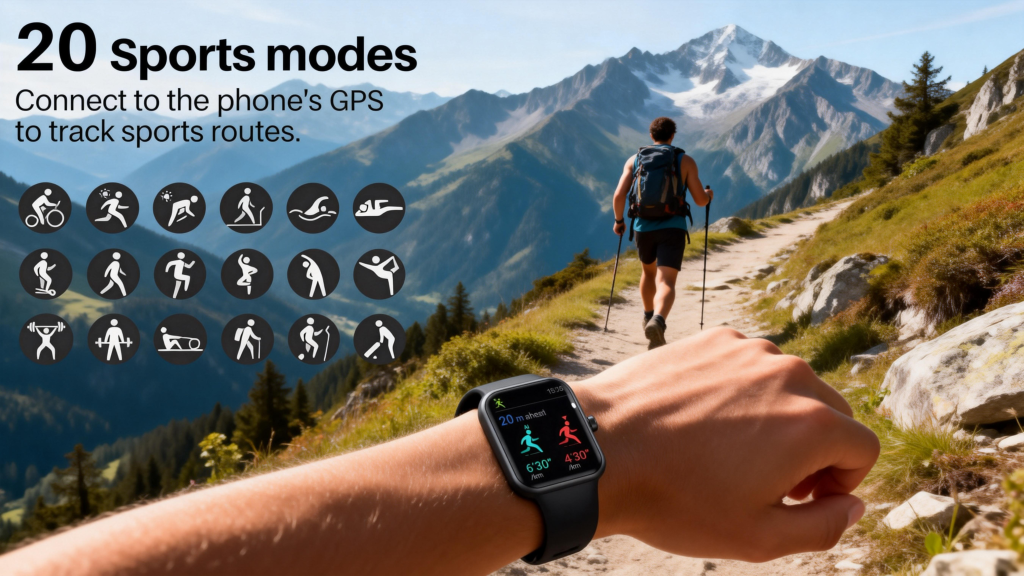
In fitness tracking, gyroscopes dramatically improve activity classification. Accelerometers alone might confuse brisk walking with arm-only exercises like shadowboxing. Adding rotation data lets the watch recognize cycling (steady roll from pedaling), swimming strokes (distinct pitch/roll patterns per style—freestyle, breaststroke, etc.), or even yoga poses where wrist orientation changes predictably. During runs or hikes, it helps filter out arm swing artifacts that would otherwise inflate or deflate step counts.
Navigation gets a boost too. When GPS signal drops—in tunnels, dense forests, or tall buildings—gyroscopes provide short-term dead reckoning. Fused with accelerometer and compass data, they estimate heading changes and distance traveled until satellites reconnect. This “inertial navigation” keeps your map arrow pointing the right way for seconds to minutes, reducing frustrating jumps on the display.
Advanced Features That Depend on Gyroscopes
Fall detection benefits enormously from gyro input. A real fall often involves rapid rotation—tumbling forward, sideways, or backward—before the hard impact caught by the accelerometer. Gyroscopes spot these angular rates (sometimes exceeding 200–300°/s), helping algorithms differentiate a genuine fall from simply sitting down fast or dropping your arm. Many watches now require both sensors to agree before triggering an alert.
Sleep stage estimation and automatic workout detection also lean on gyroscopes. Nighttime wrist rotations reveal turning over or restless periods more reliably than acceleration alone. For workouts, sudden changes in orientation (like flipping from face-down plank to upward dog) help the watch switch modes without manual input.
Some premium models use gyroscopes for more niche tricks: stabilizing compass readings against magnetic interference, improving augmented reality overlays (if the watch supports basic AR), or even assisting in golf swing analysis by tracking clubface rotation through the swing path.
Limitations and Real-World Trade-offs
Gyroscopes aren’t perfect. They suffer from drift—small errors accumulate over time because they’re measuring rate of change, not absolute position. Without periodic correction from GPS, magnetometer, or accelerometer gravity reference, heading can wander by several degrees per minute. High-end watches mitigate this through constant sensor fusion and calibration routines (often done automatically when you move your arm in figure-8 patterns or during GPS locks).
Temperature changes affect MEMS gyros too—thermal drift can introduce bias shifts, though modern chips include compensation circuits. Vibration from bumpy trails or heavy gym work can add noise, requiring robust filtering.
Battery impact remains the biggest practical limit. Full 3-axis gyro at high sample rates chews through power faster than accelerometer-only modes. That’s why many watches offer “battery saver” GNSS or activity profiles that disable or downsample the gyro when high precision isn’t critical.
As chips get smaller, more accurate, and lower-power, gyroscopes will enable even finer motion tracking. We’re already seeing sub-degree-per-second noise floors in flagship devices, opening doors to medical-grade tremor detection, advanced gesture languages, or seamless handoff between watch and phone AR experiences.
For now, the gyroscope remains the unsung partner to the accelerometer—together they turn raw wrist movements into reliable insights about your activity, safety, and interaction with the device. The next time your watch rotates the screen perfectly, detects your swimming stroke, or keeps your map steady underground, remember it’s the gyro quietly measuring every twist and turn that makes it possible.
Leave a Comment
Your email address will not be published. Required fields are marked *