
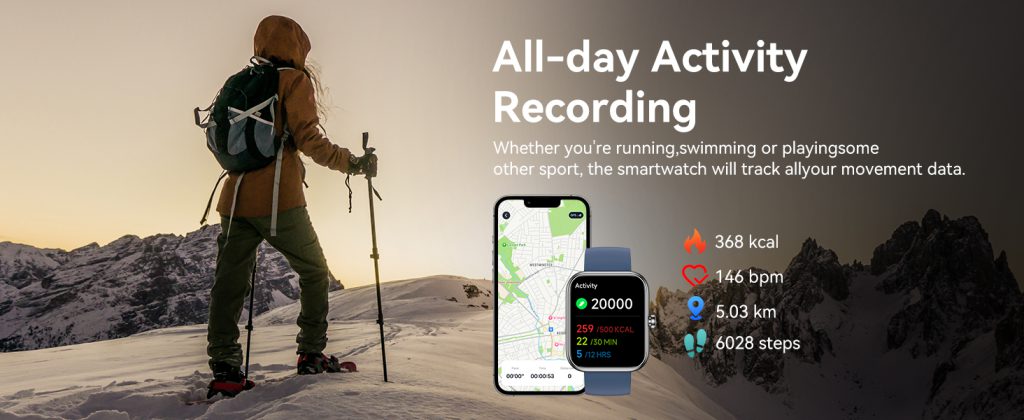
For hikers and outdoor enthusiasts, a smartwatch is more than a timepiece. It is a navigation tool and a safety device. Among its most valuable features is altitude tracking, which helps users understand their progress, plan their route, and stay aware of their environment.
How Smart watches Measure Altitude
Altitude tracking in modern smartwatches relies primarily on two methods: GPS and barometric sensors .
GPS calculates altitude by triangulating satellite signals. While useful, this method has limitations. Satellite signals can bounce off terrain or become blocked by dense tree cover, leading to errors. In deep canyons or thick forests, GPS altitude readings may fluctuate significantly .
The more reliable method for hiking is the barometric altimeter. This sensor measures atmospheric pressure, which decreases as altitude increases. Barometric sensors provide continuous, high-resolution data about ascent and descent, even when GPS signals are weak . However, they are sensitive to weather changes. A dropping pressure reading might indicate a gain in elevation, or it could mean a storm is approaching. High-end watches solve this by using sensor fusion—combining barometric data with GPS fixes and terrain models to correct for weather-related drift .
Essential Features for Hikers
When selecting a smartwatch for hiking, several features matter beyond basic altitude readings.
Barometric Altimeter: A dedicated altimeter is essential for accurate elevation tracking. Some watches allow manual calibration at trailheads using known elevation markers, which improves precision over long distances .
GPS and Navigation Support: Multi-band GPS support improves accuracy in challenging terrain by connecting to multiple satellite systems simultaneously . Many outdoor watches now offer offline topographic maps, allowing hikers to view contour lines, trails, and landmarks without a phone signal . Some devices also support GPX route imports, enabling users to follow pre-planned routes and receive alerts if they stray off course .
Compass and Environmental Sensors: A built-in digital compass helps with orientation when trails are unmarked. Some watches also include thermometers for monitoring conditions, though accuracy varies depending on wrist placement .
Battery Life: Altitude tracking and GPS use significant power. For multi-day trips, battery life becomes critical. Many outdoor-focused watches offer extended battery modes that balance accuracy with endurance, lasting anywhere from 36 hours to several weeks depending on settings .
Accuracy Considerations
No consumer device provides perfect elevation data. Even the best watches have margins of error, typically within 3–5% of the true value over long distances . Users should focus on relative changes over time rather than absolute numbers for fitness tracking purposes.
Factors that affect accuracy include:
- Weather: Rapid pressure changes can temporarily skew readings.
- Temperature: Extreme heat or cold can cause sensor drift.
- Calibration: Starting with a known elevation improves performance .
For critical applications like race qualifying or navigation in remote areas, cross-referencing with topographic maps or external sources is recommended.
Practical Tips for Hikers
To get the most reliable altitude data on the trail:
- Allow the watch to stabilize outdoors for several minutes before starting a hike .
- Calibrate the altimeter at a known elevation point, such as a trailhead sign or summit marker .
- Enable all available satellite systems for better GPS accuracy .
- Keep the watch firmware updated to benefit from improved algorithms .
- Download offline maps and route data before leaving cell coverage .
Altitude tracking transforms a smartwatch from a simple activity recorder into a genuine hiking companion. It provides real-time awareness of progress, helps with navigation in unfamiliar terrain, and contributes to safety by enabling features like storm alerts and trackback functions . While no device is infallible, understanding the technology and its limitations allows hikers to use these tools effectively and confidently on any trail.
Leave a Comment
Your email address will not be published. Required fields are marked *