
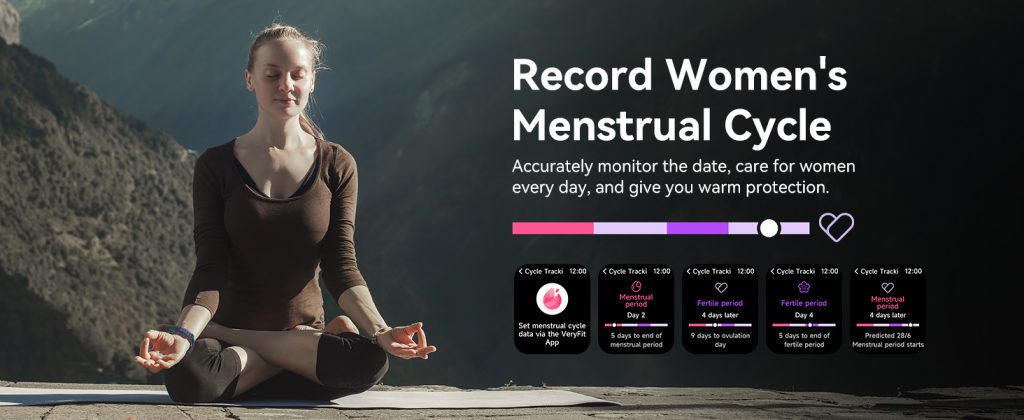
We bought smart watches to count steps, close rings, and measure sleep. But over the past few years, these wrist computers have quietly evolved into something more personal: fertility assistants.
What Your Watch Actually Measures
Unlike period-tracking apps that rely on manual logging, smartwatches collect physiological data you didn’t even know you were giving.
Heart rate is the primary indicator. Your resting heart rate naturally rises slightly after ovulation and stays elevated until your period starts. The watch detects these subtle shifts—sometimes just 2-3 beats per minute—and correlates them with your cycle.
Temperature tells the story. Many high-end watches now measure wrist skin temperature while you sleep. After ovulation, progesterone causes your body temperature to rise by about 0.3-0.5°C and remain elevated. When it drops, your period is imminent.
Some watches even analyze heart rate variability, respiratory rate, and sleep patterns. Each data point adds another layer of accuracy.
The Interpretation Challenge
The watch doesn’t actually “see” your ovulation or period. It infers them from patterns.
The algorithm compares your nightly data against your historical baseline. If your temperature has been consistently higher for three days and your heart rate shows a shift, the system flags this as the luteal phase.
But bodies aren’t textbooks. Stress, lack of sleep, or even a glass of wine can spike your temperature and confuse the algorithm. This is why most watches ask you to log your actual period start date—it recalibrates the predictions.
Privacy at a Cost
We rarely think about where this data lives. Menstrual cycle information is deeply personal, yet it syncs to cloud servers, passes through company databases, and sometimes even shares with third-party health platforms.
Recent debates around reproductive health data in the US have made this more urgent. Some brands now offer end-to-end encryption for cycle data or store it locally on the device. Before you sync your cycle to your watch, it’s worth asking: who else has access?
Tool, Not Doctor
After six months of using cycle tracking on my smart watch:
It’s remarkably accurate at predicting period start dates—mine has been within 24 hours for the past four cycles. But it struggles with irregular cycles and cannot reliably detect ovulation without additional manual tracking.
Use it as a convenience, not a diagnostic tool. It won’t replace a fertility specialist or an obstetrician. But as a way to understand your body’s rhythms with minimal effort? It’s surprisingly powerful.
The future of women’s health technology isn’t in apps we have to feed—it’s in devices that quietly observe and learn.
Leave a Comment
Your email address will not be published. Required fields are marked *