
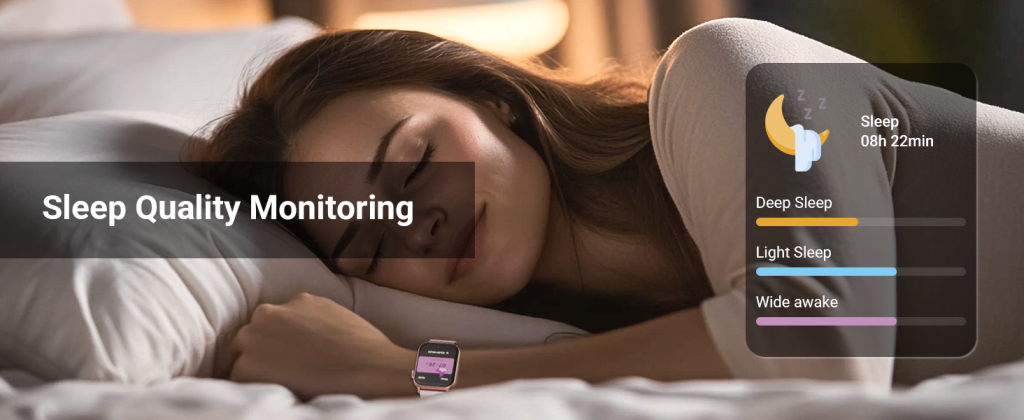
Sleep isn’t just “lights out” time—it’s a structured sequence of brain and body states that repeat in roughly 90-minute cycles. Sleep stage classification gives names and rules to these phases so researchers, doctors, and now smartwatch algorithms can speak the same language about what happens after you fall asleep. The standards have evolved over decades, and today’s wearables draw directly from them to label your nights as light, deep, REM, or awake.
The Foundation: AASM Manual (The Modern Gold Standard)
Since 2007, the American Academy of Sleep Medicine (AASM) has published the most widely accepted manual for scoring sleep stages. Updated periodically (the current version is the AASM Scoring Manual v3.0+), it defines five main categories based on brain waves (EEG), eye movements (EOG), and chin muscle tone (EMG).
- Wake (W) — Alert or drowsy with high-frequency, low-amplitude brain waves (alpha rhythm when eyes closed), frequent eye blinks or movements, and normal muscle tone.
- N1 (Light Sleep, Transition) — The drowsy bridge into sleep. Theta waves replace alpha, slow rolling eye movements appear, and muscle tone starts to drop. This stage usually lasts only 5–10 minutes.
- N2 (Light Sleep, Core) — The bulk of most nights. Sleep spindles (short bursts of 11–16 Hz activity) and K-complexes (large, slow waves) mark this stage. Eye movements stop, muscle tone remains low.
- N3 (Deep Sleep / Slow-Wave Sleep) — The most restorative phase. Delta waves (0.5–2 Hz, high amplitude) dominate at least 20% of the epoch. No eye movements, very low muscle tone. Hardest to wake from; growth hormone release and tissue repair peak here.
- REM (Rapid Eye Movement) — Dream-rich sleep. Brain waves resemble wakefulness (sawtooth theta, low-voltage mixed frequencies), rapid eye movements occur, but muscle tone is almost absent (atonia) to prevent acting out dreams. Heart rate and breathing become irregular.
A full night typically includes 4–6 cycles, with more deep sleep early and longer REM periods toward morning.
How Wearables Adapt These Standards
Polysomnography (PSG) in a sleep lab uses full EEG, EOG, and EMG—gold-standard tools. Smartwatches lack brain-wave electrodes, so they approximate stages using wrist-based proxies:
- Motion (accelerometer/gyroscope) → stillness for deep, fidgeting for light/wake
- Heart rate and HRV patterns → stable low rate for deep, variable for REM
- Sometimes SpO2 or breathing rate → dips or irregularities can flag REM or disturbances
Algorithms are trained against PSG datasets, mapping sensor patterns to AASM-like labels. Accuracy for total sleep time often reaches 85–95%, but stage-by-stage agreement drops (especially confusing N1/N2 or overestimating deep sleep). The goal isn’t perfect PSG replication—it’s reliable trends for everyday users.
QONBINK follows this scientific backbone closely, blending precise motion filtering with overnight heart-rate and HRV analysis to deliver stage breakdowns that feel consistent and trustworthy across different sleep environments.
Why Standards Evolve and What’s Next
The AASM rules aren’t set in stone. Earlier systems (Rechtschaffen & Kales, 1968) used only four stages and lumped N1/N2 together. The 2007 shift to N1–N3 split light from deep more clearly and reflected new understanding of slow-wave sleep’s importance. Future updates may incorporate autonomic signals (like HRV) more formally or address individual differences (age, sex, medications).
For consumers, the value lies in consistency over absolute precision. A watch that reliably shows you’re getting less deep sleep after late coffee or poor room temperature can guide real improvements—earlier bedtime, cooler bedroom, reduced evening screens—far more effectively than chasing lab-level accuracy.
Making the Data Work for You
Don’t fixate on hitting “perfect” percentages every night—sleep needs vary by age, stress, exercise, and health. Instead, watch month-over-month trends:
- Are deep and REM percentages trending up after lifestyle tweaks?
- Do frequent wake periods align with known stressors or alcohol?
- Does readiness or recovery score improve when you prioritize 7–9 hours?
Used this way, stage classification becomes less about rigid medical scoring and more about personalized feedback that nudges better habits.
Leave a Comment
Your email address will not be published. Required fields are marked *