
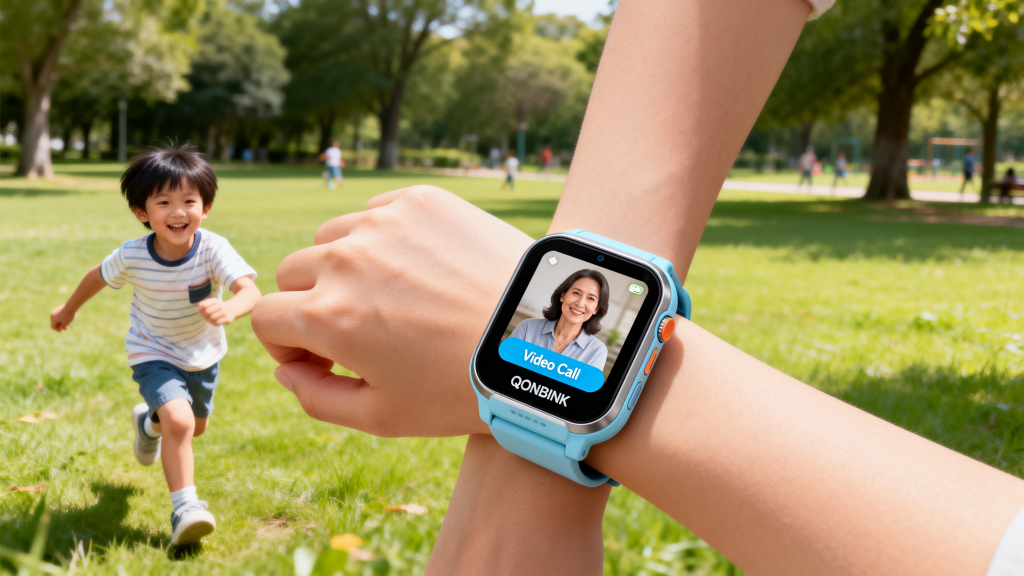
There is a moment in every modern parent’s life that arrives unannounced. It usually happens around the time your child starts walking to school alone, or when they beg to go to the park with friends, or when you realize that the bus schedule is unreliable and you have no way of knowing if they actually made it to class. In that moment, you start thinking about a smartwatch. Not a phone. You’re not ready for a phone. But a watch? A watch seems manageable. It straps to their wrist. It can’t be lost in a backpack. It has GPS so you can see that little dot on the map, confirming they are exactly where they should be. It feels like the perfect compromise between your need for peace of mind and their need for independence.
And for a while, it is perfect. You get the notification that they’ve arrived at school. They call you from a friend’s house to ask if they can stay for dinner. You feel relieved, even a little smug, that you’ve solved the connectivity problem without handing over a glowing rectangle that will consume their every waking hour. But then, slowly, you start to notice things. They’re up late, the watch glowing under the covers as they exchange messages with classmates. They come home talking about so-and-so’s new watch with the better camera, and you catch the faintest whiff of something you weren’t ready for: peer pressure. They beg you to let them download a game, then another, then another. The watch that was supposed to be a safety tool has somehow become a tiny smartphone strapped to their wrist, and you’re back to square one, fighting the same battles you were trying to avoid.
This story is playing out in millions of homes right now. The kids’ smartwatch market has exploded, and with good reason. These devices offer genuine safety benefits that no previous generation had access to. But they also introduce a host of new challenges that parents never signed up for. The question isn’t whether to buy a smartwatch anymore. The question is how to manage one once it’s on your child’s wrist.
Let’s start with the obvious benefit, the reason most parents take the plunge in the first place. GPS tracking in modern kids’ smartwatches has become remarkably sophisticated. It’s not just about seeing a dot on a map anymore. You can set up safe zones around your home, your child’s school, a trusted friend’s house, and receive an instant alert the moment they enter or leave those areas . Some models use dual-band GPS that can pinpoint location within a few meters, even in dense urban environments where tall buildings usually confuse signals . For a parent waiting at home while a child walks home from school, that peace of mind is literally priceless. You’re not constantly glancing at the clock, wondering if you should call. You know. The watch told you.
Then there’s the communication layer. Kids can call or send voice messages to a pre-approved list of contacts . No unknown numbers can reach them. No strangers sliding into DMs. It’s communication in a carefully controlled bubble, and for many families, that’s exactly the right balance. Some watches even include an SOS feature. A button held for a few seconds triggers an alert to parents with the child’s location, a digital lifeline in situations no one wants to imagine but every parent secretly worries about . The Garmin Bounce 2, for example, lets kids press and hold the top button to start a countdown; if they don’t cancel it, the watch sends their location and a live tracking link to selected contacts . It’s the kind of feature you hope never gets used, but its presence changes the calculus of letting your child venture out into the world.
The activity tracking built into these watches adds another layer of value, though it’s one that parents often overlook. Kids are naturally active, but the simple act of seeing step counts and movement goals can encourage even more outdoor play . Some watches gamify physical activity, turning exercise into a challenge with rewards and virtual achievements. The Fitbit Ace LTE offers around sixteen hours of active use and motivates kids to stay moving . The Garmin Bounce 2 tracks an exhaustive list of sports and activities, from running and cycling to team sports, presenting the data in kid-friendly formats that still provide the detail parents might appreciate . It turns the watch from a passive tracking device into an active participant in your child’s physical health.
But here is where the story gets complicated. The same device that gives you peace of mind can also become a source of anxiety for your child. A scoping review published in Translational Pediatrics examined the impact of smartwatches on children and found that up to twenty-five percent of pediatric smartwatch users experienced anxiety arising directly from the device . Think about that. One in four kids felt more anxious, not less, because of the watch on their wrist. The study documented cases where children misinterpreted normal variations in their heart rate, with some believing that a low heart rate meant they were about to die . The algorithms in these watches are designed for adults, and when applied to children, they can generate false alarms that send families rushing to doctors for conditions that don’t exist. The number of children visiting cardiologists because of smartwatch-generated heart concerns jumped from two in 2017 to fifty-seven in 2021, and of those fifty-seven, only three had actual arrhythmias . That’s a lot of unnecessary fear and medical expense driven by a device meant to provide security.
The social dimension adds another layer of complexity. Smartwatches for kids have become status symbols, and nowhere is this more visible than in the dominance of certain brands. In China, one brand holds over thirty-five percent of the market, and its proprietary “bump to add friend” feature has become a social passport among children . Parents report that if their child doesn’t have that specific brand, they can’t connect with classmates, leading to social exclusion and pressure to upgrade. The watches have evolved from tools into toys, with features like customizable avatars, point systems, and even gray markets where kids buy and sell accounts with high “like” counts . There are reports of hacked parental controls being sold online for a hundred dollars, and accounts with millions of likes going for thousands . What started as a safety device has spawned its own miniature economy, complete with all the social pressures and anxieties that parents hoped to delay.
The educational impact is real and documented. Schools across multiple countries have had to develop policies around smartwatch use. Many now ban them entirely during school hours, or require that they be collected at the start of the day and returned at dismissal . The distraction is simply too great. Children check messages during lessons, play games under their desks, and lose focus on the work in front of them. Some parents worry about this, but others actively encourage it, wanting the reassurance of being able to reach their child at any moment. The tension between connectivity and concentration is one that every family has to navigate on its own terms.
Then there are the physical concerns. The screens on these watches are small, much smaller than the tablets and phones that already raise concerns about eye strain. Children with developing vision are spending hours staring at these tiny displays, often holding them close to their face to read messages or play games . The long-term effects aren’t fully understood, but common sense suggests that frequent, prolonged use of small screens is not ideal for young eyes. Add to that the skin contact issues. Wearing a watch continuously, especially during sleep, can cause skin reactions. The materials, even those marketed as hypoallergenic, can irritate sensitive skin, and sweat trapped under the band creates a breeding ground for bacteria . Parents are advised to clean the bands regularly and to remove the watch periodically to let the skin breathe .
The battery itself presents another set of considerations. Lithium-ion batteries in children’s devices are supposed to meet strict safety standards, including tests for overcharging, crushing, and heat exposure . New regulations in some countries require that children’s smartwatches be designed so they cannot be used while charging, eliminating the risk of a child wearing a watch that’s plugged into an outlet . Parents should be vigilant about charging habits. If a watch becomes hot during charging, or if the battery life suddenly drops significantly, those are warning signs that something may be wrong . Never let a child sleep with a watch that’s charging, and always use the charger that came with the device.
The privacy implications are perhaps the most unsettling. A smartwatch on your child’s wrist is a data collection device. It knows where they are, who they talk to, how fast their heart beats, when they move and when they’re still. All of that data is transmitted, stored, and potentially shared. Regulations in some regions now require that companies create specific privacy policies for children’s data, displayed prominently where parents can review them . The same rules mandate that watches establish a dedicated content pool for children, filtering out inappropriate material and actively promoting content that supports their development . But regulations only go so far. Parents need to be the final line of defense, reviewing privacy settings, understanding what data is being collected, and opting out of anything that feels excessive.
The payment features add another layer of risk. Many kids’ smartwatches now include payment capabilities, allowing children to make purchases with a tap. New regulations require that when payment features are first activated, the watch must clearly present the terms and obtain parental consent . Parents should have full visibility into transaction history and the ability to set spending limits . But even with these safeguards, the presence of payment functionality turns the watch into a potential financial vector. Kids can make in-app purchases, buy digital goods, or accidentally subscribe to services without understanding the consequences. Parental oversight here isn’t optional. It’s essential.
So where does this leave the modern parent? The decision to buy a smartwatch for a child is not simple, and pretending otherwise does everyone a disservice. The first step is honest self-reflection. Why do you want this device? If the answer is purely safety, if you genuinely need the GPS tracking and the ability to reach your child, then you’re starting from the right place. But if the answer includes phrases like “all their friends have one” or “it will keep them entertained,” you might want to pause. Entertainment is not a good reason to put a connected device on a child’s wrist. There are cheaper, safer ways to keep kids amused.
If you do decide to proceed, the next step is choosing the right device. Not all smartwatches are created equal, and the differences matter enormously. Look for watches that prioritize parental controls. You want the ability to approve every single contact, to block unknown callers entirely, to set school hours where the watch becomes a simple timepiece, and to monitor usage without being obvious about it . Some of the best options run on proprietary operating systems that don’t support open internet access or third-party app stores . They are closed ecosystems by design, and that’s exactly what you want. A watch that can download games and browse the web is not a safety device. It’s a phone in disguise.
The physical design matters too. Look for rounded edges, secure clasps, and bands made from breathable, skin-friendly materials like soft silicone or fabric . Check the water resistance rating. If your child swims or plays in the rain, you need a watch that can handle it. IP68 is a good benchmark, indicating the watch is dust-tight and can survive immersion in water . But remember that water resistance degrades over time. Seals wear out. A watch that survived the pool last summer might not survive it this summer.
Once the watch is on their wrist, your job is just beginning. Set clear rules about when the watch can be used. School hours should be off limits unless there’s a specific need . Bedtime too. The watch should be charged outside the bedroom, eliminating the temptation to stay up late messaging friends. Review the contact list regularly. Kids are trusting, and they might add people they don’t really know. Check the location history occasionally, not to spy, but to understand patterns. If your child says they went straight to school, but the watch shows a detour to the park, that’s a conversation worth having.
Talk to your child about the watch itself. Explain what it does and why you gave it to them. Make sure they understand that the GPS tracking is about safety, not surveillance. Some children, especially as they enter adolescence, can feel suffocated by constant location monitoring . The watch that was meant to protect them can start to feel like a leash. Be open to adjusting the settings as they get older. Maybe you don’t need real-time tracking for a thirteen-year-old. Maybe check-ins a few times a day are enough. The goal is to gradually transition from active monitoring to trust, preparing them for a world where they’ll eventually have a phone and complete freedom.
Stay informed about the devices themselves. Software updates can change functionality, adding new features or altering how parental controls work. Check the companion app periodically to ensure your settings haven’t been silently changed. Read news about the brand you chose. If a security vulnerability is discovered, you want to know about it before it affects your child.
The school question is one you need to answer early. Before you buy, check whether your child’s school allows smartwatches. Many don’t, and if the watch has to stay in a backpack all day, its utility drops significantly . Some schools have adopted a middle ground: parents can apply for permission, and if granted, the watch is collected at the start of the day and returned at dismissal . This approach preserves the safety benefit for the commute while eliminating the classroom distraction. If your school has such a policy, respect it. Work with the administration rather than against them.
The most important thing to remember is that a smartwatch is not a replacement for parenting. It doesn’t teach your child how to be safe. It doesn’t build their judgment. It’s a tool, nothing more, nothing less. The alerts it sends are just data points. What you do with that information, how you talk to your child about it, how you balance safety with independence—that’s the real work. No device can do that for you.
The smart watch era is here, and it’s not going away. These devices will only get more sophisticated, more capable, and more integrated into our children’s lives. The challenge for parents is to harness their benefits while containing their risks. It’s possible. Thousands of families do it successfully every day. But it requires intention, vigilance, and a willingness to have hard conversations. The watch on your child’s wrist is watching back. Make sure you’re the one in control of what it sees.
Leave a Comment
Your email address will not be published. Required fields are marked *