
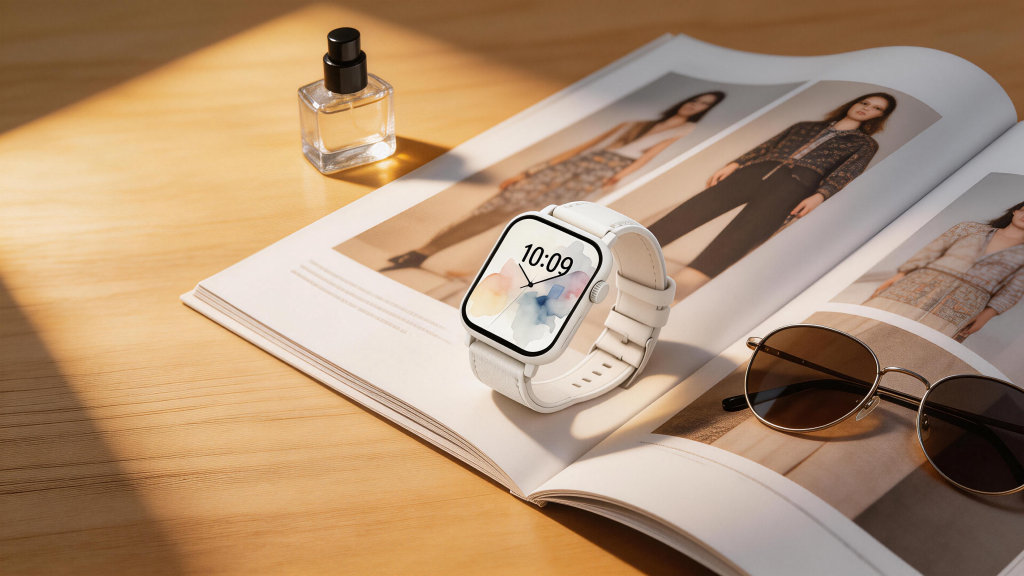
There is a moment that every smart watch owner dreads. It usually happens in the least dramatic way possible. You glance down at your wrist, and the light catches the screen just right, illuminating something you hadn’t noticed before. A scratch. Maybe it’s a hairline micro-scratch, barely visible unless you tilt the watch at a specific angle. Maybe it’s a deeper gouge, one you can actually feel with your fingernail. Your heart sinks just a little. That pristine, glossy display that looked so perfect on day one now has a permanent blemish. And the worst part? You have no idea when it happened.
This moment is almost a rite of passage for smartwatch owners. It happens to nearly everyone, and it happens because we fundamentally misunderstand what we’re dealing with. We look at our smartwatch screens and assume they’re built like the screens on our phones, or perhaps even tougher because they’re designed for the outdoors. The reality is far more complicated, and far more vulnerable. Your smartwatch screen is engaged in a constant, invisible war with the world around it. It battles keys in your pocket, desk surfaces at work, metal railings on your morning commute, and the surprisingly abrasive dust particles that settle on everything. And unlike your phone, which spends much of its life safely in a pocket or bag, your watch is exposed, all day, every day, right there on the front lines attached to your wrist.
The science behind this vulnerability is straightforward but rarely explained. Different screens use different materials, and each material has a specific hardness rating measured on something called the Mohs scale. This scale, ranging from one to ten, ranks minerals based on their ability to scratch one another. Talc sits at one, diamond at ten. Most standard glass sits around five or six. The Gorilla Glass found on many premium smartwatches reaches six or seven. Sapphire crystal, used in luxury models and some high-end variants, ranks at nine, second only to diamond. Here is the uncomfortable truth that manufacturers don’t advertise: sand, which contains quartz, ranks at seven on that same scale. This means that a microscopic grain of sand, something so small you’d never notice it, is harder than Gorilla Glass. Every time you wipe your screen with a cloth that has picked up a single grain of dust, you are essentially dragging sandpaper across your display. The scratches aren’t a sign of poor quality. They are a sign of physics.
Understanding this changes everything. It shifts the question from “why did this happen” to “what can I do about it.” And the answer starts with accepting that no matter how advanced the materials become, your screen will never be invincible. The goal is not to make it bulletproof. The goal is to make it last.
The most effective defense you can deploy is also the simplest: a screen protector. This tiny piece of glass or film acts as a sacrificial layer, taking the abuse that would otherwise mar your actual display. When you think about the cost of replacing a smartwatch screen, which can often run into hundreds of dollars or a significant percentage of the watch’s original price, spending ten or twenty dollars on a protector feels less like an accessory and more like insurance. And unlike insurance, which only pays out after something bad happens, a screen protector prevents the bad thing from happening in the first place.
But not all protectors are created equal. The market is flooded with options, and choosing the wrong one can be almost as frustrating as having no protection at all. The material matters. Tempered glass protectors, typically rated at 9H on the pencil hardness scale, offer the best scratch resistance and maintain the smooth, responsive feel of the original screen. They are slightly thicker than other options, but modern versions are so slim that they become nearly invisible once applied. For users with curved screens, TPU or hydrogel films offer a different advantage. These flexible protectors conform to the curves perfectly and even have a self-healing property, where minor scratches disappear over time. They are less resistant to sharp impacts than glass, but for certain screen shapes, they are the only option that covers edge to edge without lifting.
The installation process is where most people abandon their good intentions. They buy a protector, try to apply it in a dusty room, end up with bubbles and trapped lint, and either live with the mess or throw the protector away in frustration. The truth is that installation is not difficult, but it requires a method that most people skip. The environment matters more than you think. A bathroom after a hot shower, when the steam has settled the dust in the air, is actually an ideal workspace. Turn off the watch so the black screen makes dust easier to see. Clean the screen thoroughly with the alcohol wipe provided in your kit, then dry it with the microfiber cloth. Then comes the step that separates success from failure: the dust removal. Use the sticky dust sticker to gently tap the entire screen surface, picking up any microscopic particles the cloth missed. When you look at the screen from an angle under good light, it should look absolutely pristine. If you see even one speck of dust, remove it before proceeding.
When you’re ready to apply, do not just peel the entire backing off and drop the protector onto the screen. That is a recipe for misalignment and trapped bubbles. Instead, peel only part of the backing, align the protector carefully using the edges of the watch as a guide, and then slowly lower it while pressing gently from the center outward. If you see a bubble forming, do not panic. Use your fingernail or a soft card wrapped in the microfiber cloth to push the bubble toward the nearest edge. Bubbles that contain no dust will usually disappear within a day or two as the adhesive settles. Bubbles with dust are more stubborn, but even those can sometimes be fixed by lifting the nearest corner of the protector with a piece of tape, using the dust sticker to remove the particle, and then lowering the protector again.
Once the protector is on, your relationship with your watch changes. You no longer have to flinch every time your wrist brushes against a door frame. You can wear it with confidence, knowing that the thing taking the damage is replaceable. But the protector itself needs care. The oleophobic coating that repels fingerprints will wear down over time, especially if you clean the screen with harsh chemicals. Stick to a microfiber cloth for daily cleaning. If you need to disinfect, a 70% isopropyl alcohol wipe is safe for glass protectors, but avoid getting it on the edges where the adhesive might be exposed.
Beyond the protector, your habits matter just as much. Think about what your wrist touches during the day. That desk you rest your hand on while typing? It collects microscopic debris. The gym equipment you grab during a workout? Metal and grit. The simple act of being aware of these contact points can prevent a lot of damage. When you’re not wearing the watch, store it somewhere safe. A soft pouch, a dedicated watch stand, or even a clean pocket in your bag is better than tossing it into a drawer with keys and coins. If you wear your watch while gardening, working on a car, or doing any activity that involves sand or abrasive materials, consider taking it off. These environments are the enemy of glass.
The band you choose also plays a role in screen protection that most people never consider. Metal bands, especially those with loose links, can actually slap against the screen during movement, causing micro-abrasions over time. Silicone and fabric bands are generally safer, but they can trap grit against the case. The solution is not to avoid certain bands, but to clean regularly. Remove the band occasionally and wipe down the area where it attaches to the watch. Debris loves to hide in those small spaces.
There is also a persistent myth that needs to be put to rest: the idea that you can fix scratches with toothpaste. This is one of those internet tips that sounds plausible but causes more harm than good. Toothpaste contains mild abrasives designed to polish teeth. When applied to glass, it does not fill scratches. It grinds down the surrounding surface, effectively creating more scratches in an attempt to make the existing ones less visible. It also strips away any oleophobic coating, leaving your screen more vulnerable to fingerprints and smudges. The same applies to baking soda and other DIY remedies. Once a scratch is in glass, it is there to stay. The only real solutions are prevention or replacement.
For those who already have scratches and are living with them, there is still hope, though it comes with caveats. Some liquid glass screen protectors claim to fill in microscopic scratches by bonding with the surface at a molecular level. These products can improve the appearance of very fine scratches, but they are not a magic fix for deeper damage. They also add a layer that changes the surface feel slightly. If the scratches are deep enough to catch your fingernail, no liquid will fix them. At that point, you have to decide whether to live with them, replace the screen, or simply cover them with a new protector that might hide the damage from view.
The economics of screen protection are worth considering honestly. A high-quality screen protector costs somewhere between ten and thirty dollars. A decent protective case that wraps around the watch bezel adds another ten to twenty. For less than fifty dollars, you can outfit your watch with a level of protection that will last for years, replacing only the protector when it eventually cracks or wears out. Compare that to the cost of a screen replacement, which on many watches exceeds two hundred dollars, and the math becomes obvious. Protection is not an expense. It is a savings.
But there is another dimension to this that goes beyond money. Your smartwatch is a personal device. It tracks your heart rate, your sleep, your steps. It buzzes with messages from people you love. It sits on your wrist through workouts and meetings and quiet evenings at home. Over time, it becomes part of your daily rhythm. Keeping it in good condition is not about vanity. It is about respect for the tool that serves you. A pristine screen feels better to use. It is easier to read, more responsive to touch, and simply more pleasant to look at. Every time you glance down and see a clear, unblemished display, you are reminded that you are taking care of something that matters.
The technology in your wrist is remarkable. It can detect irregular heart rhythms, guide you through unfamiliar cities, and connect you to the world with a glance. But it is also fragile, not because it is poorly made, but because the very clarity that makes it beautiful is also what makes it vulnerable. The trade-off between visibility and durability is one that no manufacturer has fully solved. Glass will always be glass. It will always be susceptible to the physics of hardness and the abrasive nature of the world.
This is not a reason to be paranoid. It is a reason to be smart. Apply a protector. Be mindful of where you put your wrist. Clean your watch regularly with the right materials. Store it properly when it is not on your arm. These are not burdensome tasks. They are small habits that take seconds but pay dividends in years of continued use. The scratch you prevent today is one you will never have to look at tomorrow.
The next time you catch the light hitting your screen at just the right angle, and you see nothing but a perfect, clear surface, remember that this did not happen by accident. It happened because you made a choice. You chose to protect something that matters. And in a world where we are surrounded by things that break, wear out, and degrade, that small act of preservation feels quietly powerful. Your watch will eventually be replaced by something newer, faster, shinier. But until that day comes, it deserves to look its best. So does the wrist it sits on. Take the ten minutes. Apply the protector. And never flinch at a door frame again.
Leave a Comment
Your email address will not be published. Required fields are marked *