
Sealing technology is what stands between a smart watch’s delicate internals and the real world of sweat, rain, pool water, and accidental spills. Without effective seals, even the most advanced electronics would fail quickly from corrosion or short circuits. The goal is simple: create barriers that block liquid while allowing necessary movement, sound transmission, and occasional pressure changes—all in a package that stays slim, comfortable, and durable for years.
The most critical seal is usually the one around the display. A precision-molded gasket—typically made from high-performance silicone, fluorosilicone, or perfluoroelastomer—sits in a groove between the case and the crystal. When the assembly is screwed or adhesively bonded together, the gasket compresses to form a continuous, uniform barrier. These materials resist compression set (permanent deformation after long-term pressure), maintain elasticity across wide temperature ranges (-20°C to 80°C or more), and withstand exposure to sweat acids, sunscreen oils, and chlorine without swelling or breaking down. In higher-end watches, double-gasket designs add redundancy: if the outer seal degrades slightly over time, the inner one still holds pressure.
Buttons and rotating crowns are notoriously difficult to seal because they require mechanical action through the case wall. Classic crown designs use a dynamic O-ring that slides along the shaft as you twist. A thin layer of special grease lubricates the seal and prevents water from wicking along the metal. Over thousands of rotations, though, the O-ring can develop micro-abrasions or lose elasticity, so many modern watches switch to non-penetrating digital crowns. These use magnetic Hall-effect sensors or capacitive coupling—no hole through the case, no seal to wear. Side buttons often employ double O-rings stacked in series or flexible silicone bellows that deform under finger pressure without creating an opening. Some designs mold multiple buttons into a single continuous silicone membrane, eliminating individual penetrations and reducing potential leak paths to just one bonded interface.
Acoustic ports for speakers and microphones demand a different approach. Sound waves need to pass freely, but liquid must stay out. The standard solution is a thin, microporous membrane made of expanded PTFE (ePTFE). This material has billions of tiny pores—small enough to block water droplets via surface tension yet large enough for air and sound to move through with minimal attenuation. The membrane is heat-sealed or adhesively bonded around its perimeter and protected by a stainless-steel or polymer grille. During submersion, hydrostatic pressure presses the membrane against its support structure, but the hydrophobic surface sheds water quickly once the watch emerges, restoring full audio clarity within seconds. Advanced implementations layer two membranes or use oleophobic treatments to repel oils and improve longevity in sweaty conditions.
Charging interfaces used to be a common failure point. Exposed pogo pins or spring-loaded contacts invite corrosion if water bridges them. Many current designs eliminate this risk entirely with inductive wireless charging—no metal-to-metal contact, no seals required around the coil. When traditional contacts remain (for faster wired options or data transfer), each pin is individually surrounded by a tiny silicone grommet, and the entire array sits in a recessed pocket with an additional perimeter seal. Some models add a sliding cover or a tight-fitting rubber flap, though these mechanical parts can wear or collect debris over time.
Adhesives and coatings provide backup layers. Structural adhesives—often UV-cured acrylates or two-part epoxies—bond dissimilar materials (glass to metal, ceramic to polymer) with high shear strength while remaining flexible enough to accommodate thermal expansion differences. Conformal coatings—thin polymer films sprayed or dipped onto circuit boards—protect against any moisture that somehow breaches the outer seals. In extreme cases, critical components like the battery or processor are potted in silicone or epoxy, creating an encapsulated island that survives even if the primary enclosure leaks.
Pressure management is another subtle but important aspect. Air trapped inside the watch expands and contracts with temperature changes. Without relief, this could stress seals or pop the display. Some designs include tiny one-way vents covered by ePTFE membranes that equalize pressure while blocking liquid. These “breather” vents are strategically placed to minimize water entry risk during swimming or showers.
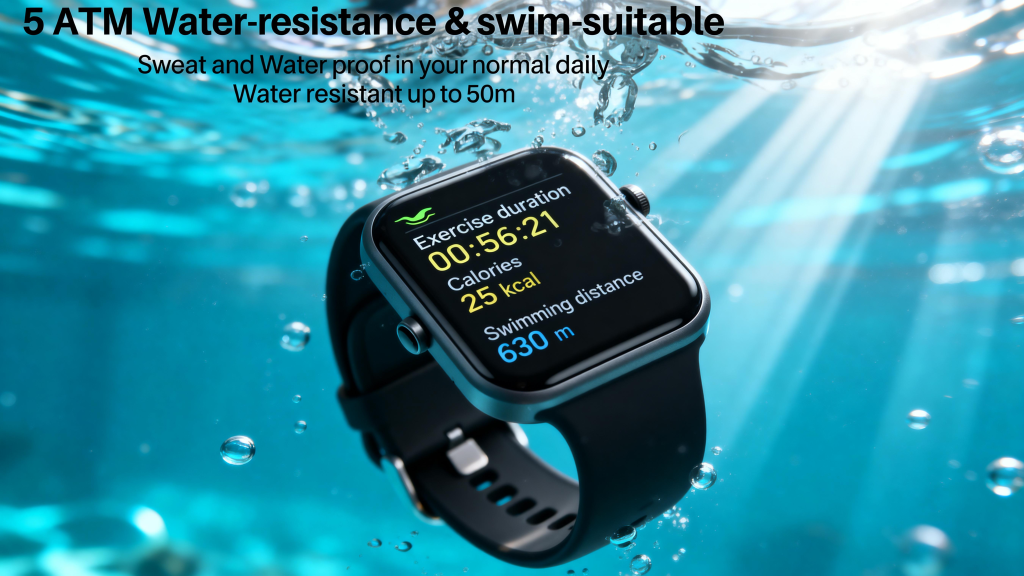
Real-world performance depends on rigorous validation. Watches undergo helium leak detection (sensitivity down to 10⁻⁹ mbar·L/s), followed by pressurized immersion tests at elevated temperatures, thermal shock cycling, salt fog exposure, and dynamic pressure shocks simulating dive entries or water jets. Ratings such as 5 ATM or 10 ATM indicate survival under static lab conditions, but ISO 22810 adds requirements for dynamic forces relevant to swimming. Manufacturers often exceed published ratings internally to account for long-term aging.
Aging remains the biggest long-term threat. Gaskets harden from heat and UV, O-rings lose resilience from repeated compression, membranes can clog with minerals or degrade chemically. Sweat, chlorine, and sunscreen accelerate these processes. That’s why service intervals are recommended—many brands suggest professional pressure testing and gasket replacement every 1–2 years for frequent swimmers.
The evolution of sealing technology has made today’s smartwatches far more reliable in wet environments than earlier generations. From passive gaskets to active membranes, non-penetrating controls, and inductive charging, each improvement reduces failure points while preserving usability. The result is a device you can wear through workouts, storms, and daily life without constant worry about water damage—quiet engineering that lets the focus stay on the features rather than the fear of a leak.
Leave a Comment
Your email address will not be published. Required fields are marked *