
Battery life is often the first thing people complain about when they talk about smart watches, yet choosing the right battery capacity is one of the trickiest balancing acts manufacturers face. Too small, and the watch dies halfway through the day; too large, and you end up with a thick, heavy brick on your wrist. The sweet spot depends on what features the watch prioritizes, how users actually wear it, and the compromises engineers are willing to make.
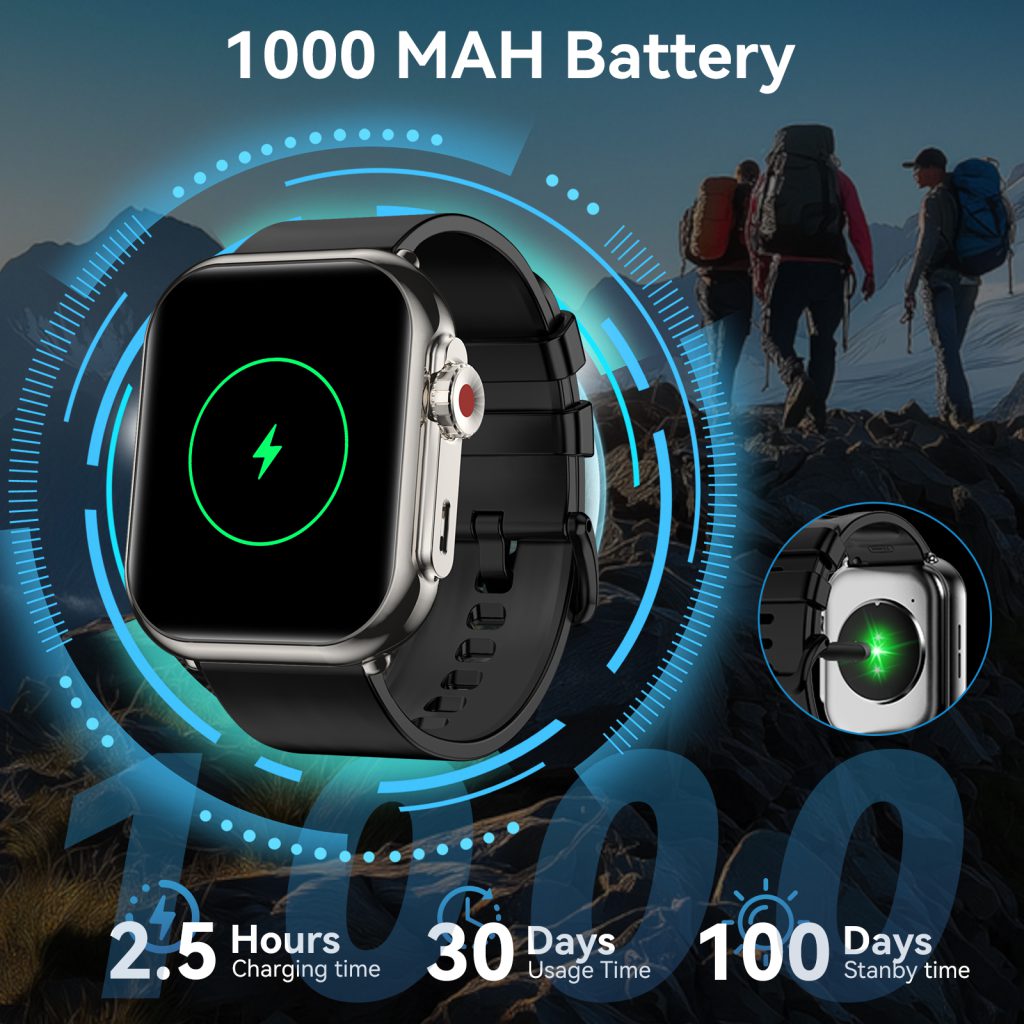
Most smart watches in 2026 carry batteries between 200 mAh and 600 mAh, though the number alone doesn’t tell the full story. Capacity is measured in milliamp-hours, which indicates how much current the battery can deliver over time, but real-world endurance hinges on power draw from the display, processor, sensors, wireless radios, and always-on features. A 300 mAh battery in a minimalist fitness tracker with an always-off OLED can easily last a week, while the same capacity in a full-featured model with a bright AMOLED, constant heart-rate sampling, GPS workouts, and LTE connectivity might struggle to reach 24 hours.
Display choice is usually the biggest power hog. Always-on displays (AOD) keep time and complications visible at a glance by running the screen at low brightness or using memory-in-pixel technology, but even dimmed, they consume far more than a raise-to-wake setup. Manufacturers offering multi-day battery life almost always disable true AOD or limit it to essential info only. Resolution and refresh rate matter too—higher pixel density and 60 Hz scrolling animations drain faster than 30 Hz or lower-res panels. That’s why rugged outdoor watches often stick to transflective or MIP displays that reflect ambient light instead of emitting it; they sip power in sunlight and still look readable.
The processor and software optimization play an equally large role. Modern wearables use ultra-low-power co-processors for background tasks—step counting, notifications, sensor polling—while the main application processor sleeps most of the time. Efficient chip architectures like Arm Cortex-M series for always-on duties and more powerful cores only waking for complex jobs help stretch capacity. Software tricks matter just as much: adaptive brightness that dims aggressively in low light, aggressive sensor duty-cycling (sampling heart rate every few minutes at rest instead of continuously), and smart power modes that disable GPS or LTE when not needed. Updates frequently improve battery life post-launch by refining these algorithms.
Sensors add incremental but cumulative drain. Continuous optical heart rate, SpO2 monitoring, skin temperature, and ECG when active all pull current. GPS is especially thirsty—dual-frequency multi-constellation tracking can consume 50–100 mA during lock-on and mapping. Watches aimed at serious athletes often include dedicated low-power GNSS chips and modes that switch to single-band or assisted positioning to conserve energy. Accelerometers and gyroscopes are relatively cheap in power terms, but high-sample-rate motion detection for fall alerts or gesture recognition adds up over days.
Connectivity features push the limits hardest. Bluetooth Low Energy for phone pairing is efficient, but Wi-Fi scanning, cellular LTE, or always-on music streaming can halve runtime. Many models offer “battery saver” profiles that disable notifications, limit vibrations, turn off AOD, and reduce sensor frequency—turning a 36-hour watch into a three-day one at the cost of functionality.
Physical size constrains everything. Wrist real estate is limited, so batteries are flattened into thin pouches rather than cylindrical cells. Larger capacities require thicker cases or smaller screens, which hurts comfort and aesthetics. Titanium or ceramic bodies allow slightly more internal volume without adding much weight, which is why flagship rugged models often hit 500+ mAh while staying wearable. Smaller fashion-oriented watches sacrifice capacity for slimness, relying on nightly charging.
User behavior shapes perceived battery life more than specs suggest. Someone who enables every notification, uses GPS for two-hour runs daily, and keeps AOD on will see half the advertised runtime of a user who treats the watch as a basic step counter with occasional workouts. That’s why real-world tests vary so widely—independent reviews often show flagship models lasting 1.5–2 days with heavy use versus the “up to 14 days” claimed in ideal minimal scenarios.
Manufacturers face tough trade-offs. Adding 100 mAh might extend life by 20–30% but force a thicker profile or smaller display. Better efficiency through new low-power components or software can add days without changing size. Some brands now use silicon-anode or solid-state battery chemistries in prototypes for higher energy density, promising longer life in the same footprint, though these remain expensive and unproven at scale.
In the end, battery capacity selection boils down to priorities. Fitness purists want multi-day endurance even with GPS tracking; urban users accept daily charging for richer features and brighter screens. The best designs find a middle ground—enough capacity for realistic use, smart power management to stretch it, and transparent marketing so expectations match reality. When a watch lasts through a full weekend of normal wear without begging for the charger, that’s the quiet victory engineers aim for.
Leave a Comment
Your email address will not be published. Required fields are marked *