
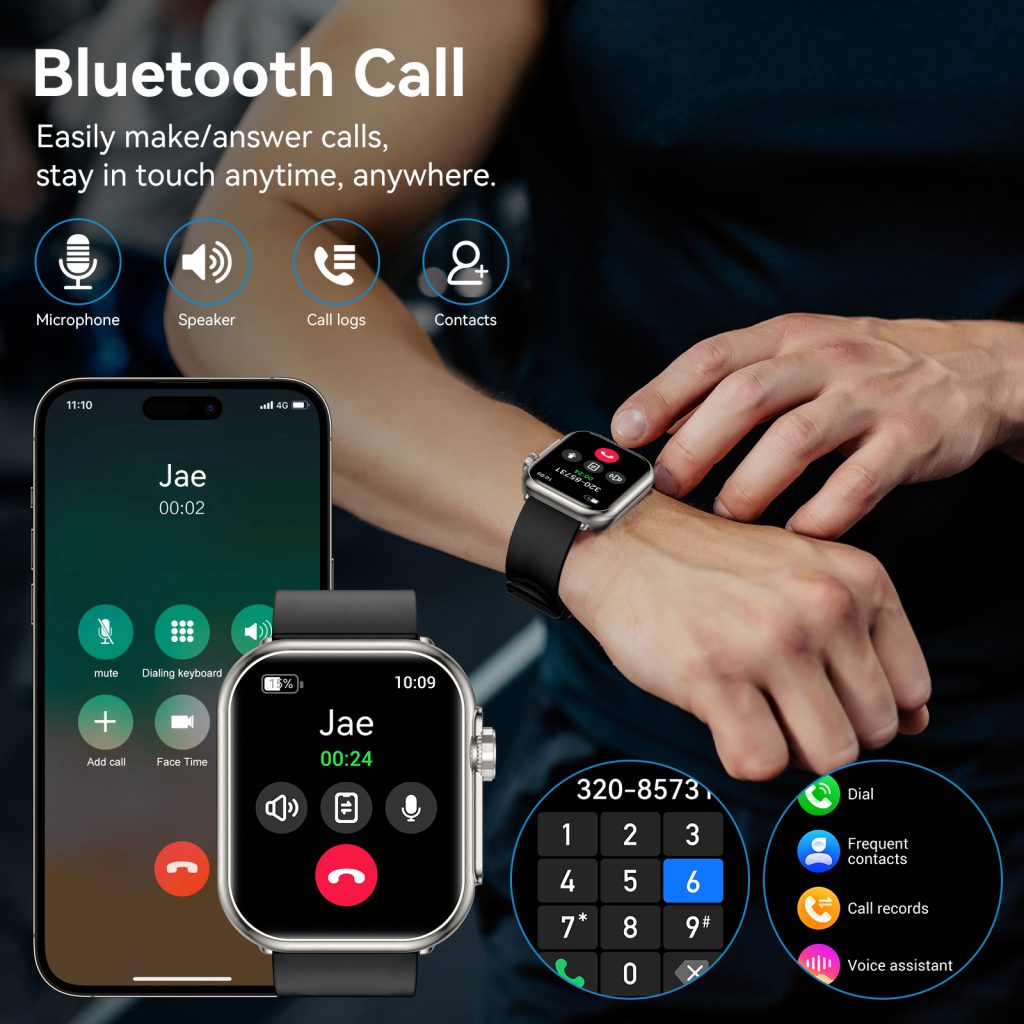
Bluetooth is the invisible thread that connects your smart watch to your phone, earbuds, and sometimes other devices. It handles calls, music streaming, notifications, data sync, and even location sharing. Over the years, Bluetooth versions have improved dramatically—faster connections, lower power use, better range, and more reliable performance. For a device that lives on your wrist and needs to last all day on a tiny battery, these upgrades matter a lot.
Bluetooth 4.0 and 4.2 – The Low-Power Foundation
When smartwatches first became popular around 2014–2016, Bluetooth 4.0 (and later 4.2) was the standard. The big breakthrough was Bluetooth Low Energy (BLE), which let devices stay connected with very little power draw. Before BLE, constant Bluetooth use would kill a watch battery in hours; with 4.0, watches could last days while still pushing notifications, syncing steps, and tracking heart rate in the background.
Bluetooth 4.2 added small but useful improvements: faster data transfer (up to 2.5× quicker in theory), better packet handling to reduce dropped connections, and stronger privacy features (randomized addresses to make tracking harder). In real life, most users noticed more stable connections in crowded Wi-Fi environments and slightly better range—maybe 10–20 meters instead of 5–10. For early smartwatches, this was enough for basic pairing, notifications, and occasional music control, but streaming high-quality audio or making clear calls often felt limited.
Bluetooth 5.0 – The Big Jump in Range and Speed
Bluetooth 5.0 arrived in 2016 and quickly became the baseline for mid-range and flagship smartwatches from 2018 onward. It doubled the theoretical speed (up to 2 Mbps vs 1 Mbps in 4.2), quadrupled the range (up to 240 meters in ideal conditions, though 30–50 meters is more realistic indoors), and improved data broadcasting for things like location beacons.
For smartwatches, the real wins were:
- Much more reliable connections in challenging environments (through walls, in gyms, or during workouts).
- Faster syncing of health data, maps, or firmware updates.
- Better support for dual audio (connecting to two devices at once, like phone and earbuds).
- Lower latency for calls and music playback.
Most users felt the difference immediately: fewer random disconnects, quicker pairing after turning the watch on, and smoother music streaming to Bluetooth earbuds without noticeable lag. Battery life improved too—BLE got even more efficient, so constant background connection drained less.
Bluetooth 5.1 and 5.2 – Precision and Audio Focus
Bluetooth 5.1 (2019) introduced direction-finding features using angle-of-arrival and angle-of-departure. In theory, this allows watches to pinpoint the direction and distance to other Bluetooth devices with centimeter-level accuracy. While full use is still emerging (mostly in indoor navigation or finding lost items), it laid groundwork for future “find my watch” or precise location sharing.
Bluetooth 5.2 (2020) brought LE Audio, a game-changer for audio quality and power. It uses the LC3 codec instead of older SBC, delivering better sound at lower bitrates. This means higher-quality music and calls while using less power. It also introduced Auracast broadcast audio—letting one watch stream to multiple earbuds or speakers simultaneously (useful for shared workouts or family listening).
In smartwatches, 5.2 enables clearer phone calls (less compression artifacts), longer music playback on a single charge, and multi-device audio sharing. Latency dropped noticeably for voice and gaming, making real-time responses feel snappier.
Bluetooth 5.3 and 5.4 – Efficiency and Future-Proofing
Bluetooth 5.3 (2021) focused on fine-tuning: lower latency, better channel classification to avoid interference, improved power management for periodic advertising, and enhanced encryption. These changes are subtle but cumulative—connections stay stable longer, reconnections happen faster after brief drops, and overall power use drops another few percent.
Bluetooth 5.4 (2023) added periodic advertising with responses (PAwR) and encrypted advertising data. These help in dense environments (crowded gyms, offices, events) by reducing collisions and improving security for broadcast features. For smartwatches, this means more reliable notifications in busy places and better support for future features like digital keys, public transit passes, or crowd-sourced location networks.
How Versions Affect Your Daily Experience
Older Bluetooth 4.x watches still work fine for basic notifications and step tracking, but they feel dated when paired with modern phones or earbuds. You might notice slower pairing, more frequent drops in crowded areas, and shorter battery life during music streaming.
Bluetooth 5.0+ watches pair faster, hold connections through walls or during movement, stream music with less lag, and last longer on the same battery. Calls sound clearer, voice assistant responses arrive quicker, and syncing large health datasets (sleep logs, GPS routes) takes seconds instead of minutes.
If you use your watch mostly for notifications and fitness tracking, Bluetooth 5.0 is plenty. If you rely on calls, music streaming, or voice commands all day, Bluetooth 5.2 or newer brings tangible improvements in clarity, reliability, and battery endurance.
Bluetooth continues evolving—5.4 is already here, and Bluetooth 6.0 is on the horizon with even better channel sounding, decision-based advertising, and monitoring features. For smartwatches, this means more precise location services, lower power for always-connected use, and richer audio experiences without sacrificing battery life.
Leave a Comment
Your email address will not be published. Required fields are marked *